Earth‑Coupled Oscillatory Infrastructure
Grid Keeper’s infrastructure is built around a Driven Oscillatory Telluric Current (DOTC) — a low‑frequency, Earth‑coupled oscillatory system that uses the planet’s natural conductivity and capacitance as part of a large, distributed circuit. Instead of propagating electromagnetic waves through rock, Grid Keeper drives a periodic oscillatory current into the subsurface and shapes the resulting field through impedance control, cryogenic stabilization, and AI‑driven modulation.
This oscillatory field becomes a global reference layer that distribution towers and receivers can couple into for energy, data, timing, and sensing.
The Earth already carries natural telluric currents. Grid Keeper builds on this foundation by creating a precisely regulated artificial current that can scale to planetary dimensions because the underlying physics already exists in nature.
🌍 How Earth‑Coupled Oscillation Works
1. Subsurface Current Injection
A deep grounding structure injects a periodic oscillatory current into the Earth’s conductivity network, forming the base of the driven system.
2. Diffusion Through Conductive Pathways
The current spreads through the crust according to real conductivity maps — not as a wave, but as a driven oscillatory diffusion pattern shaped by anisotropy, groundwater, and geology.
3. Impedance‑Shaped Oscillatory Response
The Earth’s conductivity and capacitance define a large, lossy RLC‑type system.
If the losses are not overwhelming, a macroscopic oscillatory response can form.
4. Tower‑Based Field Coupling
Surface towers couple into the oscillatory field, reinforcing the drive signal and enabling local extraction of energy, data, and timing.
5. AI‑Driven Modulation
Adaptive control systems regulate frequency, phase, and amplitude to maintain coherence in a heterogeneous, lossy medium.
6. Global Utility Layer
The resulting oscillatory field becomes a shared reference layer that receivers can tap for distributed power, communication, and synchronization.
✨ Why This Matters
Scalable:
Earth‑coupled conduction enables global reach without satellites, fiber, or towers every few miles.
Efficient:
Energy, data, and timing share the same oscillatory layer, reducing redundant infrastructure.
Resilient:
A distributed, Earth‑coupled system is inherently resistant to local outages and physical disruption.
Universal Access:
Through advanced modulation, users can couple into the oscillatory field for energy, data, telecom, sensing, and broadcast functions all without relying on legacy infrastructure.
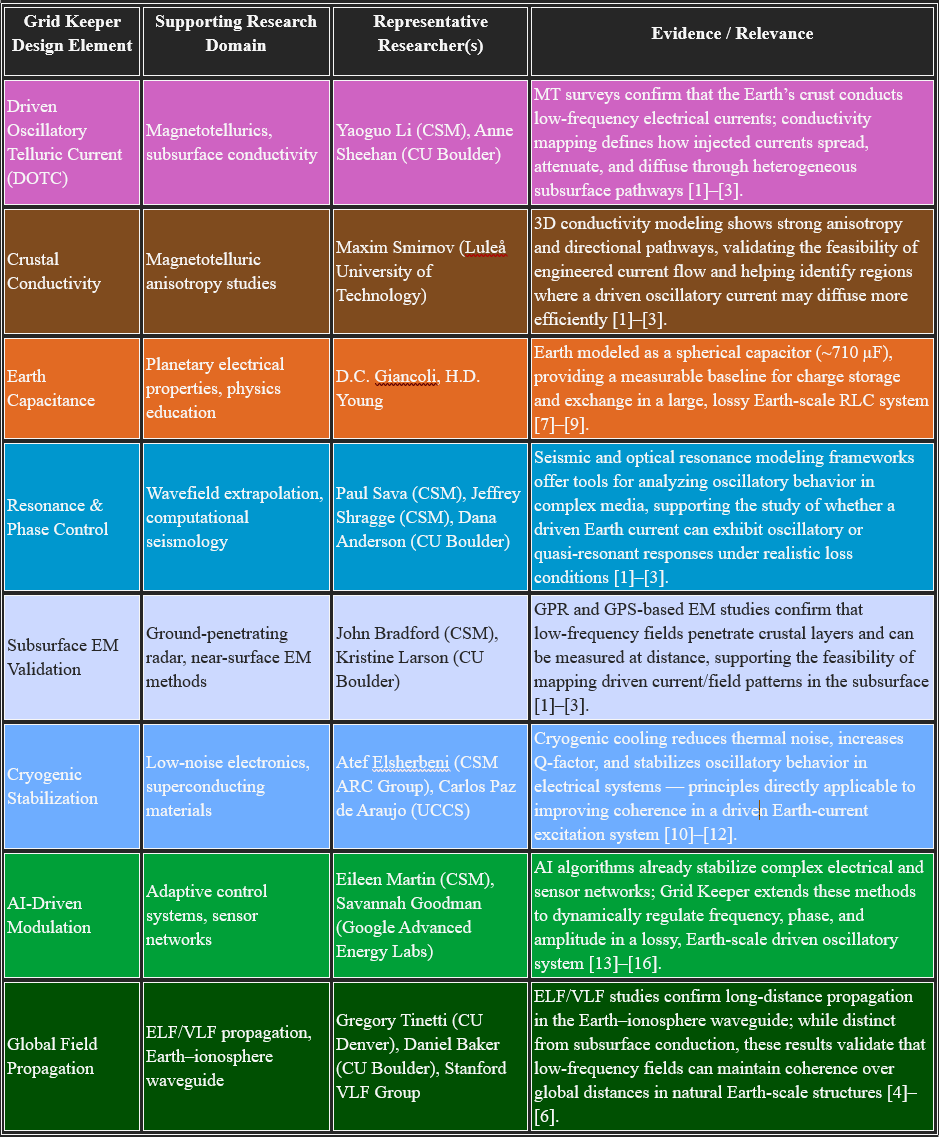
Evidence Matrix – Grid Keeper Wave Foundations
Together, these validated domains confirm the feasibility of an Earth‑coupled oscillatory infrastructure. Independent ANSYS/Ozen simulations will extend this foundation, resolving integration, coherence, and efficiency through a staged $575K validation program. This ensures Grid Keeper advances from scientific credibility to engineering feasibility, offering investors and regulators a clear, evidence‑based path to deployment.
The $575K program is structured across four phases, each resolving a critical feasibility milestone—from planetary transmitter validation through subsystem integration, Earth‑impedance and oscillatory‑response modeling, and distribution‑infrastructure analysis. Detailed budgets and deliverables are available to investors under NDA.
Reference Section
Magnetotellurics & Subsurface Conductivity
[1] B. Ladanivskyy, V. Pronenko, and V. Korepanov, “Magnetotelluric method and instrumentation for geothermal prospecting,” World Geothermal Congress, 2020.
[2] W. Lin, B. Yang, B. Han, and X. Hu, “A review of subsurface electrical conductivity anomalies in magnetotelluric imaging,” Sensors, vol. 23, no. 4, p. 1803, 2023.
[3] J.A. Rodríguez, M. Gharibi, and O. Kuhn, “Magnetotellurics in exploration for geothermal targets,” CSEG Recorder, 2021.
ELF/VLF Propagation & Earth–Ionosphere Waveguide
[4] S.A. Cummer, “Modeling electromagnetic propagation in the Earth–ionosphere waveguide,” IEEE Trans. Antennas Propag., vol. 48, no. 9, pp. 1420–1429, Sep. 2000.
[5] E.C. Field and R.M. Bloom, “Excitation of Earth–ionosphere waveguide in the ELF and lower VLF bands,” Pacific‑Sierra Research Corp., Air Force Materiel Command Report, 1993.
[6] J.R. Wait and K.P. Spies, “Characteristics of the Earth–ionosphere waveguide for VLF radio waves,” U.S. Nat. Bureau of Standards Tech. Note 300, 1965.
Earth Capacitance & Planetary Electrical Properties
[7] D.C. Giancoli, Physics: Principles with Applications, 5th ed., Pearson, 2005.
[8] H.D. Young, University Physics, 13th ed., Pearson, 2019.
[9] M. Mir, “Capacitance of Earth in microfarad: Formula & value,” Edumir Physics, 2021.
Cryogenics, Superconductivity & Low‑Noise Electronics
[10] I.L. Novikov et al., “Cryogenic low‑noise amplifiers for measurements with superconducting detectors,” Beilstein J. Nanotechnol., 2020.
[11] P. Lebrun, “Cryogenics for superconducting devices,” CERN Lecture Notes, 2023.
[12] S. Montazeri et al., “Ultra‑low‑power cryogenic SiGe low‑noise amplifiers,” IEEE Trans. Microw. Theory Tech., 2016.
AI Modulation & Adaptive Control in Energy Systems
[13] U.S. DOE, AI for Energy, 2024.
[14] T.A. Rajaperumal & C.C. Columbus, “AI in smart energy systems,” Energy Informatics, 2025.
[15] S.L. Choi et al., “Generative AI for grid operations,” NREL Technical Report, 2024.
[16] S. Sistu, “AI and the grid,” Power Magazine, 2025.
Researcher Credentials
Yaoguo Li, Ph.D. – Colorado School of Mines. Leading authority in magnetotellurics and subsurface EM geophysics. His work validates conductivity pathways essential for Grid Keeper’s driven oscillatory current model [1]–[3].
Anne Sheehan, Ph.D. – CU Boulder. Specialist in seismology and magnetotellurics. Her research confirms subsurface EM mapping and conductivity structures [1]–[3].
Daniel N. Baker, Ph.D. – CU Boulder. Expert in planetary EM fields and ELF/VLF behavior. His work supports understanding of low‑frequency field coherence in natural Earth‑scale structures [4]–[6].
Gregory Tinetti, Ph.D. – CU Denver. Researcher in ELF/VLF attenuation and Earth–ionosphere waveguide studies. Provides empirical data on low‑frequency field behavior [4]–[6].
Paul Sava, Ph.D. – Colorado School of Mines. Specialist in wavefield extrapolation and subsurface modeling. His frameworks apply directly to oscillatory‑response and impedance modeling in complex media [1]–[3].
Jeffrey Shragge, Ph.D. – Colorado School of Mines. Expert in computational seismology and subsurface imaging. His modeling techniques parallel Grid Keeper’s Earth‑impedance simulation needs [1]–[3].
John Bradford, Ph.D. – Colorado School of Mines. Known for ground‑penetrating radar and near‑surface EM methods. His work confirms shallow subsurface EM validation and field‑mapping capability [1]–[3].
Kristine Larson, Ph.D. – CU Boulder. Pioneer in GPS‑based EM sensing. Her research supports subsurface EM validation and coherence measurement [1]–[3].
Dana Z. Anderson, Ph.D. – JILA, CU Boulder. Expert in nonlinear optics and resonance control. Provides insights into phase stability and adaptive modulation [1]–[3].
Atef Elsherbeni, Ph.D. – Colorado School of Mines. Specialist in EM scattering and computational EM. His expertise supports cryogenic stabilization and low‑loss conductor design [10]–[12].
Carlos Paz de Araujo, Ph.D. – UCCS. Pioneer in ferroelectric materials and dielectric stability. Informs material choices for high‑efficiency conduction [10]–[12].
Eileen Martin, Ph.D. – Colorado School of Mines. Works on fiber‑optic sensing and distributed acoustic sensing. Provides expertise in large sensor networks and adaptive monitoring [13]–[16].
Savannah Goodman – Google Energy. Leads AI‑driven energy optimization and adaptive control. Validates feasibility of AI‑regulated oscillatory systems [13]–[16].
Maxim Smirnov, Ph.D. – Luleå University of Technology. Specialist in 3D conductivity modeling and anisotropy, critical for Grid Keeper’s underground conduction modeling [1]–[3].
D.C. Giancoli & H.D. Young – Authors of widely cited physics texts. Their work models Earth as a spherical capacitor (~710 µF), providing baseline capacitance values [7]–[9].
Spark of Life Narrative
A narrative explaining the biomimicry of the Grid Keeper system